Information submitted
Authorised guest registrations, relevant updates and incident reports.
 Veyra StaysProperty OperationsClient login
A proposal for Century City Property Owners Association
Connecting owners, building security and existing providers through a controlled CCPOA visitor and incident service.
Proposal for discussion. CCPOA participation, responsibilities and information-sharing arrangements remain subject to agreement, legal assessment and any required authorisation.
The gap this addresses
A disruptive rental group can return using a different lead guest. A new booking name can leave another building without relevant information about a previous incident.
The proposed service checks the actual guests and supports a careful review of relevant history. A shared booking or group association alone does not establish wrongdoing.

From authorisation to review
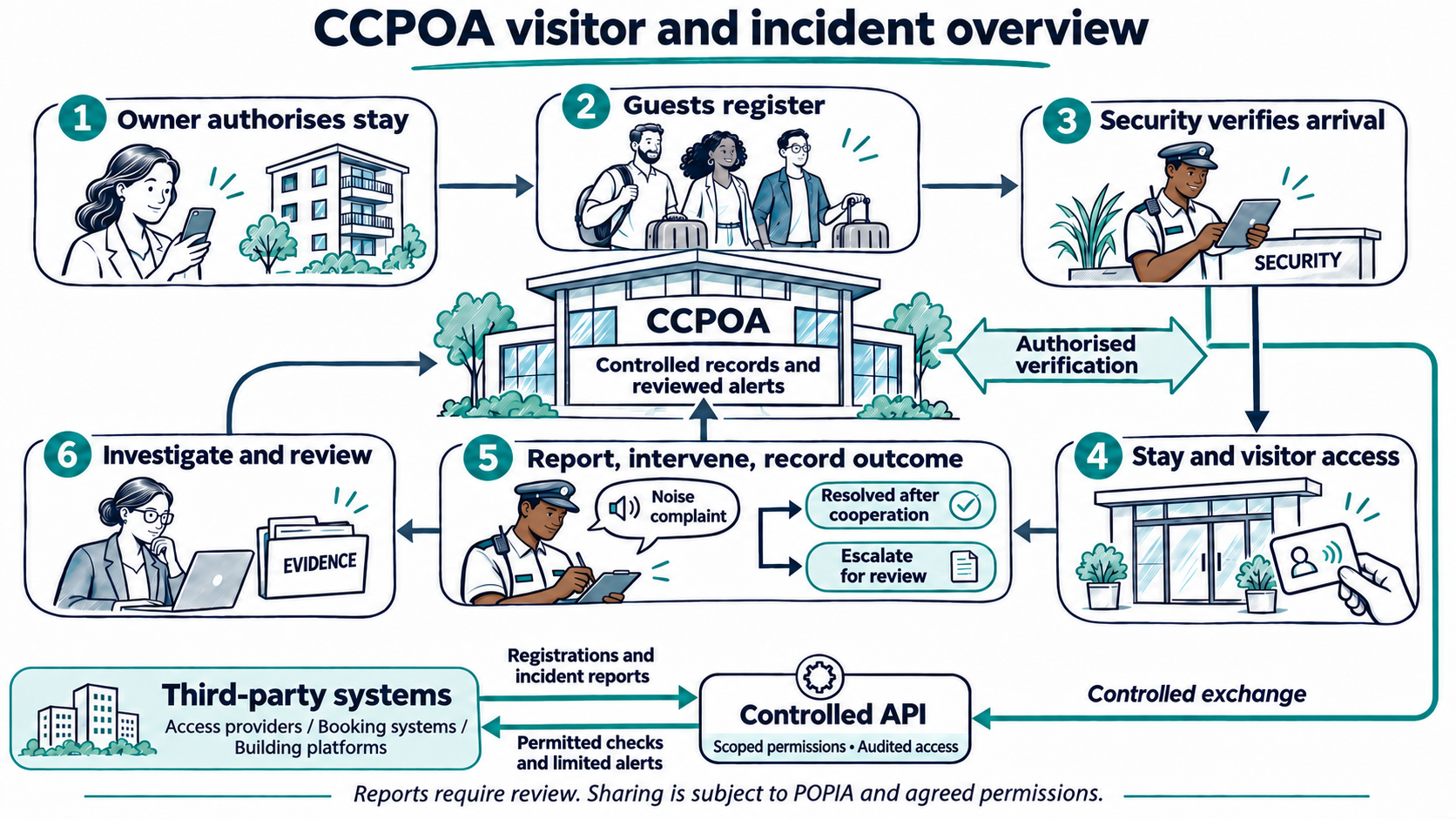
The owner or managing agent submits the intended occupants, unit and stay dates, with a responsible contact and backup.
Each actual guest joins the authorised stay record. Additional day visitors follow the building's approval process.
Security checks arrivals against the authorised guest list. Returning guests match to existing records through an agreed verification method.
Individual permissions cover the approved building, areas and visit period. Owner escalation gives security a clear contact when help is needed.
Guards distinguish complaints from observations, record their intervention and check whether the guests cooperate or the disturbance recurs.
Designated reviewers assess evidence and individual responsibility. Relevant, permitted alerts can inform later human decisions.

Clear responsibility
Owner authorisation and arrival verification answer different questions: who may stay, and who actually arrives.
Individual access passes follow the permitted visit. A responsible host and backup contact help security resolve problems promptly. Recurring substantiated incidents and slow owner responses can also be reviewed by unit.
Participation through a controlled API
Access providers, booking systems and building platforms could contribute through documented interfaces. The proposed CCPOA core is free and open source, with protected personal records.
Authorised guest registrations, relevant updates and incident reports.
Scoped permissions
Audited access
Permitted verification results and limited alerts for authorised review.
Each integration receives permissions for its agreed functions and building relationships. Participation does not provide general database browsing or unrestricted personal histories. Providers such as ATG are potential participants, subject to agreement and technical assessment.
This page describes the proposed CCPOA model. It does not announce a live CCPOA integration or a confirmed third-party partnership.
An accurate account of what happened
A noise complaint arrives. Security contacts the apartment and requests lower volume. What happens next matters.
Security confirms that the guests complied and the disturbance ended. The record includes that cooperation.
Security records continuing or recurring noise, further interventions and escalation for review. Multiple complaints about one event remain linked to the same incident.
A new visitor has no established history. Numerical reputation scoring remains a policy option for later assessment.

Fair review and limited sharing
Reports, observed facts and substantiated outcomes stay distinguishable. Individual consequences need evidence of involvement.
A relevant flag prompts authorised review. It does not automatically refuse a booking or entry.
Use only necessary information, with role-based access, audit records, retention limits and a correction process.
Confirm the lawful sharing model and any required Information Regulator authorisation before live processing. Broad registration consent alone does not resolve every obligation.
Legal references: POPIA and Information Regulator prior-authorisation guidance.
A defined first step
Bring willing buildings and providers together to agree responsibilities, the lawful model, operating costs and measures of success.
Start with synthetic records, then begin a limited live pilot once the necessary approvals and controls are in place. Later options could include disclosed noise-level alerts and emergency visitor accounting.